Showing posts with label books. Show all posts

Sunday, 8 April 2012

God and the future – so what?

I've been writing about the Bible's teaching on whether God knows all of the future. Firstly, I noted that several passages in the Bible seem to indicate God experiences time like we do, expressing sorrow at His actions, being surprised by what others have done, and changing His mind at times.

Then on Friday I tried to explain how we might harmonise those passages with the seemingly contradictory theme within the Bible of God determining or at least foreknowing the future. This was my conclusion:
It seems clear to me then that the Bible teaches two things about God's knowledge of the future. Some of the future is indeed known in advance by God and even set in advance by him. But not all of it. There are many passages in the Bible that speak of God experiencing time just like we do, having hopes for the future, reacting to events, being disappointed when things don't go according to his wishes. God does know the future but only to the extent that he has settled it.

But so what; what difference does it make whether or not God has complete, perfect knowledge of all that will ever happen? Or is it just, as I wrote a couple of days ago, high-falutin speculation? Well, in a way, yes it is; certainly when compared with the heart of the Christian faith. It's Easter Sunday today so I'm all the more aware of how everything pales into insignificance alongside the victory over evil that Jesus won through his death and resurrection.

And yet... Greg Boyd (his book 'God of the Possible' is what's got me thinking about all this) picks out seven ways in which he thinks the open view of God and the future might have a real and positive impact on us. I'll focus on just a couple.

Let's start with our view of the Bible. Many doctrines of Christianity have arisen in order to make sense of apparent contradictions in the Bible. For example, we have the doctrine of God's incarnation as the 1st century Jewish man, Jesus of Nazareth. This doctrine seeks to make sense of the Bible seeming to say that Jesus is both fully human and fully God.

In the same way, the open view of God and the future seeks to make sense of two apparently contradictory threads in the Bible; God has foreknowledge of the future but also experiences events as we do, reacting and making plans in response to them. The open view, says Greg Boyd, 'provides us with a framework in which the Word in its entirety begins to make sense on this issue'. And as we gain a more coherent view of what the Bible teaches, so increases 'our ability to understand God more clearly, relate to him more sincerely, and be transformed by him more profoundly'.

The next practical issue is about prayer. If we believe God sees all of time as settled then what does it mean for us to pray? What difference can our prayers possibly make if we don't really believe that God can change his mind? Christians sometimes talk as if God controls everything, as if prayer is only about conforming our own will to God's will. But, according to Boyd, this 'simply doesn't reflect the purpose or the urgency that Scripture gives to petitionary prayer'. Boyd goes on to say this:
Because God wants us to be empowered, because he desires us to communicate with him, and because he wants us to learn dependency on him, he graciously grants us the ability to significantly affect him. This is the power of petitionary prayer. God displays his beautiful sovereignty by deciding not to always unilaterally decide matters. He enlists our input, not because he needs it, but because he desires to have an authentic, dynamic relationship with us as real, empowered persons. Like a loving parent or spouse, he wants not only to influence us but to be influenced by us.

The Bible consistently speaks of prayer as something that can change God's mind (e.g. see Luke 18:1-8 and 2 Chronicles 7:14), so wouldn't it be great if our theology reflected this?

I could go on. Greg Boyd's book mentions seven practical benefits of this open view of God and the future. Drop me a line if you're local to me and would like to borrow the book; I'd love to know what you think about it all. And if you're still finding it hard to swallow this idea that God doesn't know all that will ever happen, I'll leave you with this from page 86 of God of the Possible:
Classical theology cannot accept this conclusion because of philosophical preconceptions of what God must be like: He must be in every respect unchanging, so his knowledge of the future must be unchanging...

Because of this philosophical presupposition, God is not allowed to say what he wants to say in Scripture. Suppose, for the sake of argument, that God wanted to tell us he really does change his mind. How could he do so in terms clearer than he did in passages such as Jeremiah 18:8 and 10 in which he explicitly tells us, “I will change my mind”? Or suppose, for the sake of argument, that God wanted to tell us he really does regret certain decisions he's made and really does experience unexpected disappointment. How could he do so in terms clearer than he did in passages such as 1 Samuel 15:11 in which he explicitly tells us, “I regret that I made Saul king,” or Jeremiah 3:7 in which he tells us, “I thought... 'she will return to me'; but she did not return”? It's difficult to conceive of how God could be more explicit.


Photograph of Oxford University by ALAMY, taken from the Daily Telegraph

Friday, 6 April 2012

God does know the future

Earlier this week I asked the question, 'Does God know the future?' (Read the post here.) A book I've been reading has made me rethink the traditional view of God's omniscience that says he sees all of time as if it were the present.

The key problem with the traditional view is there are many Bible passages that talk about God being surprised, expressing sorrow, and changing his mind. How can those passages make sense if God does indeed have foreknowledge of everything that will happen? How can a being who has complete, perfect knowledge of the future be surprised?

However, and it's a big 'however', the idea of God having full knowledge of the future appears to have a solid Biblical basis. I mentioned a few passages in my previous post:
You saw me before I was born. Every day of my life was recorded in your book. Every moment was laid out before a single day had passed. (Psalm 139:16)
Remember the things I have done in the past. For I alone am God! I am God, and there is none like me. Only I can tell you the future before it even happens. Everything I plan will come to pass, for I do whatever I wish. (Isaiah 46:9-10)
This is what the Lord says: “You will be in Babylon for seventy years. But then I will come and do for you all the good things I have promised, and I will bring you home again. For I know the plans I have for you,” says the Lord. “They are plans for good and not for disaster, to give you a future and a hope.” (Jeremiah 29:10-11)

Let's see what one advocate of the so-called 'open view' of God and the future has to say about these three passages. That book I've been reading is 'God of the Possible' by Greg Boyd and what follows is all based on arguments from it.

I'll leave until last the first of the three Bible passages above, as the argument from Boyd's book is quite technical and lengthy. The second passage (Isaiah 46:9-10) seems fairly clear, though. God says, 'Only I can tell you the future before it even happens' and 'Everything I plan will come to pass, for I do whatever I wish'. But this doesn't say God can tell all the future, just some of it. And how much of the future God can tell is entirely up to him, for 'everything he plans will come to pass'. I don't see any indication from this passage that God knows the whole of the future.

Next, we have the famous verse from Jeremiah 29:
“For I know the plans I have for you,” says the Lord. “They are plans for good and not for disaster, to give you a future and a hope.”

Just before this verse, we see God stating the Israelites will be in captivity for seventy years. If we're going to take this at all literally then it's clear God has the power to set or at least predict the future. But again there's no sense (is there?) from this passage that God sets or even simply foreknows all the future. Just certain aspects.

As for the 'I know the plans I have for you' promise, is it heretical to suggest that God's plans don't always come to fruition? I feel quite strongly about this point because believing that God's plans do always become reality leads, in my view, to some dangerous places. People are robbed of their free will, for a start, and it makes me wonder what Jesus was thinking when he told us to pray 'May your will be done'.

On to Psalm 139 then. Greg Boyd gives two pages (from p40) of his book 'God of the Possible' to verse 16 from this Psalm:
You saw me before I was born. Every day of my life was recorded in your book. Every moment was laid out before a single day had passed.

I'm going to focus on two aspects of Boyd's argument concerning this passage, starting with some points about the original language it was written in. Boyd says that the Hebrew word translated 'laid out' or 'formed' can carry the sense of being determined in advance or merely being planned. I guess which sense we prefer will be conditioned by what we feel the rest of scripture teaches...

There's more, though. According to Boyd, the Hebrew is not clear as to what the subject is in the sentence. What is 'recorded in God's book' and 'laid out before a single day had passed'? Apparently it could be the psalmist's physical form or the days of his life; either would be an accurate translation. Boyd prefers the former option, that it's the psalmist's body which was recorded in God's book:
[This view] has the advantage of being consistent with the rest of this psalm and especially with the immediate context of this verse. Psalm 139 is about God's moment-by-moment, intimate involvement in our lives. The verses immediately preceding verse 16 describe the formation of the psalmist's body in the womb. Indeed, the first stanza of verse 16, “Your eyes beheld my unformed substance,” also concerns the intimate awareness the Lord has of the psalmist even before he's formed. An interpretation of this verse that continues this theme seems most appropriate, whereas one that inserts an unrelated reference to the psalmist's future seems out of place.

The second point I want to pick out is this. Even if Psalm 139:16 is about the psalmist's life (not his physical body), must we accept that the length of his life couldn't be altered, having been 'recorded in God's book'? If you're baulking at the idea of God's intentions changing, have a quick read of these passages:

Exodus 32:33
Revelation 3:5
Isaiah 38:1-5
Jeremiah 18:6-10

According to Boyd, 'The notion that what God ordains is necessarily unalterable is foreign to the Hebrew mind'. To envisage God as being completely unchanging in every respect is to follow Greek and Roman thought, not Hebrew thought. Those of us who consider the Bible to be 'inspired by God' and 'useful to teach us what is true' (2 Timothy 3:16) mustn't import other philosophies and world-views into the Bible. It's the other way round; we must let the Bible shape and inform our world-view.

It seems clear to me then that the Bible teaches two things about God's knowledge of the future. Some of the future is indeed known in advance by God and even set in advance by him. But not all of it. There are many passages in the Bible that speak of God experiencing time just like we do, having hopes for the future, reacting to events, being disappointed when things don't go according to his wishes. God does know the future but only to the extent that he has settled it.

So what, though? I do want to explain why I think all this high-falutin' speculation is important but I'll save that for later as this post is plenty long enough already. Watch this space...

Monday, 2 April 2012

Does God know the future?

Mainstream Christian doctrine says that God is omniscient. Or in less fancy words, He knows everything. I'm beginning to have some doubts about this though. Let me explain.

Part of the idea about God's omniscience is that He knows the future; for example where you'll be living in ten years' time, who'll win Wimbledon this summer, what word I'll type next. There's plenty of material in the Bible that, on first reading, points to this view. Jesus predicts the future several times, for a start, and in the Old Testament God is recorded as saying things like this:
You saw me before I was born. Every day of my life was recorded in your book. Every moment was laid out before a single day had passed. (Psalm 139:16)
Remember the things I have done in the past. For I alone am God! I am God, and there is none like me. Only I can tell you the future before it even happens. Everything I plan will come to pass, for I do whatever I wish. (Isaiah 46:9-10)
This is what the Lord says: “You will be in Babylon for seventy years. But then I will come and do for you all the good things I have promised, and I will bring you home again. For I know the plans I have for you,” says the Lord. “They are plans for good and not for disaster, to give you a future and a hope. (Jeremiah 29:10-11)

Don't all these passages tell of a God who sees everything still to happen in the same way as we experience the present? As if the whole of time is stretched out before God like a sheet, so to Him all is in the present tense.

Well... I don't think it's this simple any more. What do you make of these passages which talk about God regretting His own actions, being surprised by the actions of others, and apparently changing His mind?
Then the Lord said to Samuel, “I am sorry that I ever made Saul king, for he has not been loyal to me and has refused to obey my command.” (1 Samuel 15:10-11)
Now, you people of Jerusalem and Judah, you judge between me and my vineyard. What more could I have done for my vineyard that I have not already done? When I expected sweet grapes, why did my vineyard give me bitter grapes? (Isaiah 5:3-4)
Set your affairs in order, for you are going to die. You will not recover from this illness... I have heard your prayer and seen your tears. I will heal you, and three days from now you will get out of bed and go to the Temple of the Lord. I will add fifteen years to your life. (2 Kings 20:1-6)
He went on a little farther and bowed with his face to the ground, praying, “My Father! If it is possible, let this cup of suffering be taken away from me. Yet I want your will to be done, not mine.” (Matthew 26:39)

What should we do with all these passages that speak of a God who is within time, much as we are? God is sorry that he made Saul king, He's surprised at His people's disobedience, He changes His mind about when king Hezekiah will die. And finally we have Jesus, in the agonies of knowing what is surely to come, pleading with the Father for another option. How does this make sense if the future is fully settled and foreknown by God?

Two points in closing, and first a request.

Please post a comment if you can think of other Bible passages that seem to indicate God knows all that will happen in the future.

I'll see if there might be another explanation that harmonises with God being surprised, changing His mind, being disappointed and so on, and I'll look again at those passages I quoted at the start of this post.

So that's point one – I'll put a follow-up post up in a few days' time that will, I hope, make the case that perhaps God doesn't know the future in full.

Secondly, this train of thought has all come from reading a book called 'God of the Possible' by an American Baptist pastor called Greg Boyd. (The link is to the church where Boyd is the senior pastor; his personal website is being updated at the moment.) He puts what I think is a compelling case, going through several arguments for the traditional God-outside-of-time view and putting forward his own interpretation for many of the Bible passages that people use to justify that traditional view. Let me know if you're interested in borrowing the book as I'd be glad to lend it to you if you're local to me.

Saturday, 17 March 2012

Team roles in Watership Down

In the early 1980s, psychologist Meredith Belbin published an analysis of the various roles needed in a team for it to perform its task most effectively. Around a decade earlier, in 1972, Richard Adams wrote Watership Down, a tale about the adventures of a group of rabbits. So well-characterised are the rabbits in Watership Down that I've been able to match the main protagonists to the team roles that Belbin identified. I think it works quite well for most of them. (The descriptions of each team role are from this page on the Belbin Associates website.)

Plant – Blackberry

Creative, imaginative, free-thinking. Generates ideas and solves difficult problems.

'Hazel', he said quickly, 'that's a piece of flat wood – like that piece that closed the gap by the Green Loose above the warren – do you remember? It must have drifted down the river. So it floats. We could put Fiver and Pipkin on it and make it float again. It might go across the river.'


Resource investigator – Bigwig

Outgoing, enthusiastic, communicative. Explores opportunities and develops contacts.

Peering through the blades of grass round his head, he could see the curve of a white back. Whatever the creature was, it was nearly as big as himself. He waited, stock-still, for some little time, but it did not move... [T]he idea of going back to the Honeycomb and reporting that he had glimpsed an unknown creature in the grass and left it alone was more than he could swallow. He turned his head and looked at Silver. Seeing that he was game, he took a final look at the strange, white back and then went straight up to the edge of the hollow. Silver followed.


Co-ordinator – Hazel

Mature, confident, identifies talent. Clarifies goals. Delegates effectively.

Late in the afternoon Hazel called everyone into the Honeycomb. 'I've been thinking things over,' he said. 'I know you must all have been really disappointed not to have got rid of me at Nuthanger Farm the other day, so I've decided to go a bit further next time.' 'Where?' asked Bluebell. 'To Efrafra,' replied Hazel, 'if I can get anyone to come with me: and we shall bring back as many does as the warren needs.'

There were murmurs of astonishment, and then Speedwell asked, 'How?' 'Blackberry and I have got a plan,' said Hazel, 'but I'm not going to explain it now, for this reason. You all know that this is going to be a dangerous business. If any of you get caught and taken into Efrafra, they'll make you talk all right. But those who don't know a plan can't give it away. I'll explain it later on, at the proper time.'


Shaper – General Woundwort

Challenging, dynamic, thrives on pressure. Has the drive and courage to overcome obstacles.

Soon he had become Chief Rabbit, having killed both the previous Chief and a rival named Fiorin. In combat he was terrifying, fighting entirely to kill, indifferent to any wounds he received himself and closing with his adversaries until his weight overbore and exhausted them. Those who had no heart to oppose him were not long in feeling that here was a leader indeed.


Monitor-evaluator – Fiver

Sober, strategic and discerning. Sees all options and judges accurately.

When [Holly] had spoken of his deliverance by the great apparition in the night, Fiver had listened attentively and asked one question, 'Did it make a noise?' Later, when Holly had gone back, he told Hazel that he felt sure there was some natural explanation, though he had no idea what it could be... Someone called out, 'What does Fiver think?' 'I'm certainly going,' said Fiver quietly. 'Hazel's perfectly right and there's nothing the matter with his plan. But I promise you this, all of you. If I do come, later on, to feel any kind of misgiving, I shan't keep it to myself.' 'And if that happens, I shan't ignore it,' said Hazel.


Teamworker – Dandelion

Co-operative, perceptive and diplomatic. Listens and averts friction.

Since entering the wood they had been in severe anxiety... Pipkin sat trembling under a fern, his ears drooping on either side of his head. He held one paw forward in an awkward, unnatural way and kept licking it miserably... [Hazel said,] Come on, Dandelion, tell us a story. I know you're handy that way. Pipkin here can't wait to hear it.' Dandelion looked at Pipkin and realised what it was that Hazel was asking him to do. Choking back his own fear of the desolate, grassless woodland, the before-dawn-returning owls that they could hear some way off and the extraordinary, rank animal smell that seemed to come from somewhere rather nearer, he began.


Implementer – Holly

Practical, reliable, efficient. Turns ideas into actions and organises work that needs to be done.

He was, rather, a stander of no nonsense who knew when duty was done and did it himself. Sound, unassuming, conscientious, a bit lacking in the rabbit sense of mischief, he was something of the born second-in-command.


Completer-finisher – Silver

Painstaking, conscientious, anxious. Searches out errors. Polishes and perfects.

They found Bluebell by the hedge at the bottom of the field. He was white-eyed and ready to bolt. 'Silver,' he said, 'I saw a bunch of rabbits – strangers, Efrafans, I suppose – come out of the ditch over there and slip across into the water-meadow. They're behind us now. One of them was the biggest rabbit I've ever seen.' 'Then don't stay here,' said Silver. 'There goes Speedwell. And who's that? Acorn and two does with him. That's everyone. Come on, quick as you can.


Specialist – Blackavar

Single-minded, self-starting, dedicated. Provides knowledge and skills in rare supply.

In the days that followed – days of clear sky and fine weather – Blackavar proved his worth again and again, until Hazel came to rely on him as much as on any of his veterans... Now, free among these easy-going strangers, [Blackavar] saw himself as a trained Efrafan, using his skill to help them in their need. Although he did all that he was told, he did not hesitate to make suggestions as well, particularly when it came to reconnoitring and looking for signs of danger.


So there you go! Maybe the group of rabbits from Sandleford did so well because, among their number, they had all the different skills and characteristics needed to make a really strong, effective team. I just want to finish with Richard Adams' mythology of how rabbits came to be as they are; the blessing of Frith (Adams' god-figure) on El-ahrairah, the ancient rabbit hero.

El-ahrairah, your people cannot rule the world, for I will not have it so. All the world will be your enemy, Prince with a Thousand Enemies, and whenever they catch you , they will kill you. But first they must catch you, digger, listener, runner, prince with the swift warning. Be cunning and full of tricks and your people shall never be destroyed.

Wednesday, 7 March 2012

Could you start a church?

I think I could start a church. How vain, huh? Of course, it all depends on what kind of church you're talking about! Read this account of someone starting a new church and let me know what you think. It's from the book I've been blogging about recently, 'Organic Church: Growing Faith Where Life Happens' by Neil Cole.
While doing some teaching in Japan, I had a dream that Heather, my daughter, started a church... I mentioned it to her just to let her know that she was on my mind and in my dreams while I was away. The next day she said, “Dad, my friends all want to do it!” “Do what?” I asked. “Start a church.” I told her that she would have to do most of the work, and I would coach and lead only a little. She said that was fine. The next day she arranged a house to meet in, picked a night of the week, and found a worship leader; flyers were soon being passed out to friends on campus.
I'd love to know what you think about this as an attitude towards the body of Christ. Is it marvellously adventurous and enterprising to just go for it like this? Or is it far better to gather theologically educated and trained people together, and also to get some oversight from a recognised denomination?

As I'm sure you've guessed, I think it's fantastic that people like Neil Cole's daughter, a school student, can start churches. There are risks with such a messy, almost casual approach to church planting, of course there are. But how wonderful that you don't need years of training in order to be involved in spreading the Kingdom of God like this! This is Cole's conclusion:
I... told them that I think Satan is more intimidated by this little church of fifteen high school kids than by any of those Godzilla-sized churches [that are widespread where Cole and his daughter live]... I showed them why I thought this way: “How many of you think you could start a church like one of those megachurches?” No one raised a hand. I asked, “How many of you think you could start a church like this one?” and all raised their hands. I asked them to look around the room at all the raised hands, and I said with a new-found soberness, “I assure you, Satan is terrified by this.”
I think you'd have raised your hand as well, right?


Post script – the church in China

I think a fascinating example of how Christianity can thrive when church is done in this kind of simple / organic way can be seen with what happened in China under the atheistic regime of Mao Zedong. Here's an extract from an essay I wrote while on my theology course last year:
Mao's Cultural Revolution sought to remove all forms of religion from China, with persecution against Christians including banishment of foreign
missionaries, confiscation of church property, execution or imprisonment
of church leaders and the banning of Christian public meetings.1 Foreign
missionaries were only allowed back in the years following Mao's death in
1976. Here is Hirsch's ['The Forgotten Ways' by Alan Hirsch] account of how their expectations and reality were poles apart:

'They [foreign missionaries and church officials] expected to find the
church decimated and the disciples a weak and battered people. On the
contrary, they discovered that Christianity had flourished beyond all
imagination. The estimates then were about 60 million Christians in
China... And remember, not unlike the early church, these people had
very few Bibles... They had no professional clergy, no official leadership
structures, no central organization, no mass meetings, and yet they grew
like mad.

Tuesday, 6 March 2012

Copying from the Master

I wrote a few days ago about the DNA of the church. If the church is the 'body of Christ' as the Bible says then it might be worth thinking about the DNA of that body, with the idea that each part should have the same basic instruction code which governs how it functions. Neil Cole, in his book 'Organic Church: Growing Faith Where Life Happens', describes this code using a neat little acronym:

Divine truth
Nurturing relationships
Apostolic mission


So what about some practical implications of this DNA idea? Well, the point about DNA is that it gives every cell a set of instructions to follow. Likewise with the church, the body of Christ; we have a core set of instructions and all is well if we follow them. But we can easily lose sight of the instructions and just end up copying how those immediately before us did things – as Neil Cole says:
[A] photocopy of a previous copy loses some definition in the image. Another generation of photocopying becomes even more corrupted. Every succeeding generation of photocopying passes on the flaws of all the previous generations. Eventually, the image is indistinguishable, and the original meaning is lost.
A common argument against doing church in a simple, organic way is that all sorts of chaos can result from the lack of top-down control or oversight. Cole again:
Loose expansion without controls may seem to lack substance and quality, making every succeeding generation worse, but this is true only if we copy each other. The solution to multiple photocopies is to copy from the master rather than other copies. So too, we must copy directly from our Master.
You can think of this in terms of churches, so each church finds its own way of carrying out the apostolic mission of bringing the good news of Christ, within the context of nurturing relationships and divine truth. A church shouldn't just do things the way its parent church or its denomination does things.

We can also apply the idea to individual people, Neil Cole believes. If you're a Christian, think back to when you first committed yourself to Christ or got involved in a church. Did you get told something like this?
You are just a baby. You're vulnerable and weak, and there's so much you don't know yet. There is a mean and wicked enemy who wants to destroy you. You need some good teaching and help, so don't worry about anything but learning right now. Go to church, make friends with Christians, and after you've grown we'll talk about getting baptized and serving. For now, just soak up as much as you can.
What this produces, Cole says, is 'helpless consumers, stuck in their nests' who have their 'mouths wide open every Sunday waiting to be fed'. We teach new believers to be reliant on other people (like pastors and youth leaders), not on the Master, Jesus Christ.

I wrote roughly a year ago about how I strongly believe that 'our rhythms of church can (unintentionally) encourage us to let our spiritual life drift between meetings'. Well, the over-protection of new Christians is just another facet of this; the way we do church in the western worlds seems, much of the time, to produce immature Christians who struggle to sustain their own walk with Jesus.

Maybe we could learn from the Mormons. Many Mormons spend a year or more on mission (often abroad), with young men being strongly encouraged to serve in this way. According to the Wikipedia article, roughly 30% of all 19-year-old Mormon men went on mission with the figure rising to 80-90% if the family is active in the church (figures from 2007). Neil Cole's thoughts on this are very interesting:
Perhaps the best reason for sending young people on a yearlong, door-knocking mission is less about making more Mormons than it is about making better ones. Facing the onslaught of questions, challenges, and debates, these young Mormons solidify their commitment – on the frontline with bullets flying overhead. The internal commitment made in this highly impressionable year sticks with them for the rest of their lives.
Cole's conclusion is that we are 'guilty of protecting new believers from depending on God'. If new Christians get actively involved in the work of the Kingdom right away, then 'we would see how quickly they are forced to pray, trust in God, listen to the Holy Spirit, and find answers'. I wonder what difference this might make in the lives of new Jesus-followers, binding them closely to the Master, the Head of the body, and teaching them to be reliant on Him – not on other people.

So if you're friends with any new Christians, how about urging them to get stuck in with telling their loved ones about Jesus, praying for people, and all that good stuff of the Kingdom. Don't shelter them until they've 'learnt the basics' and 'found their feet in the church'. What do you think?

Friday, 2 March 2012

The DNA of Christ's Body

There's a way of looking at church that extends the 'body of Christ' metaphor in the New Testament into the language of cells and DNA. Just like each cell in an organism has the same DNA (well, except the sex cells), the idea is that each cell or unit of the church should also have the same driving force. Here is one neat little way of describing this driving force:

Divine truth
Nurturing relationships
Apostolic mission


I got this from a book called 'Organic Church: Growing Faith Where Life Happens', by Neil Cole. He explains the three elements of the DNA of Christ's Body, the church like this:
A life changed by the power of divine truth lays aside the old corrupt things of the flesh and puts on the new ways of Christ (2 Cor. 5:17). This then affects the personal relationships of the Christian as love begins to flow our of a changed heart. Empowered by truth and love, the Christian is unable to contain this energy and follows the Lord's command to take the Gospel to others on apostolic mission in hope of changing this world.
Now each individual Christian is likely to have a preference for one or maybe two of these elements. Those of us with a pastoral, caring nature can do much to nurture relationships within the church; those with an outgoing, networking character will contribute to the apostolic mission element; and people with a prophetic or teaching talent will bring divine truth to the community of believers. But Neil Cole's point is that each 'cell' of the Body of Christ must have all three of the components at the same time. This is his warning of the danger of unravelling the church's DNA:
DNA is only potent when it is together... Most churches will gladly exclaim that they have all three portions of the DNA, but they have unraveled it into separate components and so lost its power.
Cole then notes that churches might have 'excellent preaching on Sundays', 'small groups during the week', and 'a strong missions committee'; handling in turn the divine truth, nurturing relationship and apostolic mission that make up the DNA of the church in this metaphor. Cole says the three elements mustn't be separated like this; they must be 'whole, intact, and in every cell'. Each element on its own can have disastrous consequences:
Mission without love is dead and can actually undermine the cause of Christ (1 Cor. 13:1-3). Relationships without truth are dysfunctional and toxic. Truth without application in relationships and mission is delusional (James 1:21-25). To separate each part [of the church's DNA] is to destroy the whole thing.

I've come across a couple of other illustrations that make the same point as Neil Cole is in his 'Organic Church' book. There's the 'Inward, Upward, Outward' idea which many people have used in different ways, that I first came across in Richard Foster's book 'Prayer'. Closer to home for me, is this diagram showing the values, purpose and direction of the church that I'm part of. This model nicely captures the union between our efforts and God's work in the transformation of our character, and our dual mission to 'make disciples of all the nations' and to 'do the same works... and even greater works' than Jesus did during his time on earth.

I'll stop there for now, but the 'Organic Church' book goes into much more depth about what this DNA metaphor means for how we should be church. I may well post again soon with some practical implications that follow from this idea. Obviously, it would be no good at all if I stopped at the theory part. Not to mention hypocritical, given what I wrote recently about the buzz of new ideas!

Wednesday, 29 February 2012

Frank Viola interviews NT Wright

Two of my favourite authors, one interviewing the other. Frank Viola and NT (Tom) Wright. Viola writes about a different way of being church (right up my street) and Wright is one of the UK's most famous theologians, writer of a series of Bible study guides and a rather epic trilogy all about the origins and early development of Christianity.

Here is a link to the interview, so have a look if you're a fan of either Wright or Viola.

Confession - this post is part of a 'plug your blog' day on Frank Viola's blog. But both he and Wright are genuinely two of my favourite Christian writers!

Thursday, 2 February 2012

Science as worship

Lots of people find it refreshing and relaxing to be outdoors, enjoying the beauty of the natural world. For many Christians, the natural world reminds them of God. And as regular readers of this blog will know, I'm firmly of the opinion that humanity's efforts to better understand the natural world should cause Christians no worry at all. Something I read in a novel today took this idea further, though; equating the practice of science as a kind of worship. In the passage, a woman is describing her aunt's vision of what science can be:
Idelba's vision of science had it as being progressively improvable, just as a matter of making it more scientific. That aspect is one of the ways you define science, as against many other human activities or institutions. So to me this makes it a kind of prayer, or worship... It is a devotional labour.

I just love this thought – that, far from being opposed to faith in God, the search for truth about the natural world is actually part of what it means to worship God.


By the way, if you've read the book (The Years of Rice and Salt) you might just remember that the little part I left out of the quotation rather changes the meaning. In the book, it says 'So to me this makes it a kind of prayer, or worship of the world'. I was struck by the idea that the scientific endeavour is an act of worship, not of the world but of the God who set it all in motion. I love it when novels send my thoughts off in interesting directions and Kim Stanley Robinson is fast becoming my favourite author!

Note to self: ideas are all well and good but I must not use them as defence mechanisms that shield me from the demands that Jesus makes on my life if I'm to be His disciple...

Saturday, 7 January 2012

A different end of the world

Here we go, then, with an alternative take on what will happen at the end of this era or system of things. I'm quite looking forward to writing this post as I enjoy exploring the boundaries of orthodox Christian belief. Some people see these boundaries as fences to keep us safely under the umbrella of God's protection, but I don't see why we need to be so cautious. So many of the renewal movements and Christian social action initiatives that have shaped the history of the faith have been pushed along by people who weren't afraid to swim against the tide of their times. Imagine if the Reformation had never happened, or if Wilberforce and others had not fought against slavery, just to quote two examples.

As I said in my post a few days ago, the typical evangelical Christian view of the end of the world is this: Jesus will return to the earth, and people will be judged according to whether they believe in Jesus, with those who do believe going on to spend eternity in God's glorious presence and those who do not either spending eternity in torment or being wiped out of existence. Brian McLaren's book, A New Kind of Christianity (or ANKOC for short) proposes a different view which starts off by focusing on an important little Greek word, parousia.

This Greek word is commonly translated as 'coming' or 'arrival'. It's used in the New Testament to describe the arrival of people in a certain place (e.g. in 1 Corinthians 16:17 and 2 Corinthians 7:6). Most often, though, it refers to Jesus in passages that are usually taken to be about Jesus' Second Coming. In particular, see 1 Thessalonians 4:13-18 and 2 Thessalonians 2. These passages refer to 'Lord himself... com[ing] down from heaven with a commanding shout, with the voice of the archangel, and with the trumpet call of God' and 'the coming of our Lord Jesus Christ and how we will be gathered to meet him'. The exact sequence of events around the Second Coming are disputed, as I noted in my previous post. Here's a diagram from Wikipedia:


It's important to note, though, that the New Testament writers seemed to believe that this 'parousia' of Jesus would happen fairly soon. Look at Mark 13 and the parallel passages in the other Gospels; Jesus says, 'I tell you the truth, this generation will not pass from the scene before all these things take place.' Some Bible versions fudge this by translating the Greek word genea as 'age' or 'nation' but I gather that in almost, if not completely, all the other times it appears in the New Testament and other documents from that time (do your own research, but here is an interesting point to start at) the word means 'generation'. Which means that Jesus, Paul and the others got it wrong if it does refer to a future, epoch-ending event...

So what if, instead, it referred to the full replacement of the Jewish religious system with the new covenant between God and humanity? From ANCOK p266-7:
[I]f the New Testament writers were in fact correct in their expectations of a close-at-hand parousia[I]... the term could mean the arrival... of a new age or era – a new season of growth. It could mean not the full arrival of 'the end of the end', but the full arrival of 'the beginning of a new beginning'. Parousia[I], in this way, would signal the full arrival, presence and manifestation of a new age in human history... This would be the age of the Spirit and grace rather than law and law-keeping. It would be the age of God's presence in a holy people being formed in all cultures rather than God's presence localised in a holy temple centralised in one city.

(Sorry for all the '…' by the way; McLaren makes several references to ideas and phrases from earlier in ANKOC, which won't make sense unless you've read the book. I hope I've managed to preserve McLaren's meaning, though.)

In New Testament times, the old covenant was clearly still in operation. Jesus himself was circumcised as a baby and accepted the title of rabbi, taking students (or disciples) as rabbis did in those times. He spoke in synagogues and, in many ways, behaved as a devout Jew. He was brought before the Sanhedrin and accused of blasphemy against God. But in AD 70, the Romans destroyed the Jerusalem Temple, bringing all of that to an end. Here is how McLaren relates these events to the arrival of a new age:
[T]he parousia – the arrival or presence – of the new era or covenant began after an in-between time during which the old era or covenant co-existed with the new. In other words, the age of the new covenant had been conceived[I] in the birth, life, teaching, good words, death and resurrection of Jesus. Then, after Easter, the new era continued gestating[I] in the community of his followers through several decades of struggle and persecution, culminating in a time of great tribulation, when persecution and danger intensified like labour pains[I]. During these years, the new age, like a gestating baby, was already[I] here, but not yet[I] fully born. During this time, the old system of animal sacrifice, priesthood, temple and holy city had not yet[I] ended, yet the new system (or covenant) that would outlast it was already[I] developing in secret.

When the Romans came to Jerusalem and crushed a Zealot-led rebellion in AD 70, the temple was destroyed, the sacrificial system ended, the priesthood was disbanded, and the old era came to its last day. With the cataclysmic last days of the old era ended, the new age, new covenant, new testament or new era was brought to full term, and its parousia[I] had come.
So this gives an alternative to the usual take on the 'Second Coming' but what about judgement? That's another thread running through the New Testament which could perhaps do with a closer look. The usual understanding is that all humanity will be judged (based on what is an interesting question – it could be faith in Christ or how we treat those in need) with those who 'pass' getting to spend eternity with God, and those who 'fail' going on to what Brian McLaren starkly describes as eternal conscious torment. Here are some illustrations...


But what if God's judgement is not about condemnation, but rather evaluation and reconciliation? I'll quote McLaren again, instead of trying to put his words into my own:
The reality of judgment seems to be a central theme across the biblical library [more on the library thing here), because in God's presence all pretence and hypocrisy, like all hidden virtues and goodness, are brought to light and our true colours shine through. This means that the true accounting, evaluation or assessment of our lives, our works, our nations, our world cannot help but happen. This true accounting, evaluation or assessment is what judgement means... As a first step in seeing judgement in our new eschatological context, we must stop defining it as condemnation. God's judgement... is not merely retributive – seeking to punish wrongdoers for their wrongs and in this way to balance some sort of cosmic equation. No, God's judgement is far higher and better than that; it involves 'putting wrong things right'. It means reconciling, not merely punishing; healing, not merely diagnosing; transforming, not merely exposing; revaluing (or redeeming), not merely evaluating...

Whatever the final judgement will be, then, it will not involve God (please pardon the crudeness of this) pulling down one's pants to check for circumcision, or scanning one's brain for certain beliefs like products being scanned at the supermarket checkout. No, God will examine the story of our lives for signs of Christ-likeness – for a cup of cold water or a plate of hot food given to one in need, for an atom of mercy shown to one who has been unkind or unthoughtful, for a visit to a prisoner or an open door and warm bed for a stranger, for a generous impulse indulged and a hurtful one denied, like Jesus. These are the parts of a person's life that will be deemed worthy of being saved, remembered, rewarded and raised for a new beginning. All the unloving, unjust, non-Christ-like parts of our lives – and of our nations, tribes, civilisations, families, churches, and so on – will be burned away, counted as unworthy, condemned (which means acknowledged for what they are) and forgotten for ever.

So when we say, with the writer of Hebrews, that 'people are destined to die once, and after that to face judgment', we are not saying, 'and after that, to face condemnation'. We are saying, with John, that to 'see God', to be in God's unspeakable light, will purge us of all darkness.

I am sorry this is rather long and dense, but I hope you have found reading it even half as interesting as I have found writing it. I don't know what to make of a lot of what McLaren says in A New Kind of Christianity, if I'm honest. It is all so appealing and hopeful but it's in such stark contrast to what I've always been taught in my time as a Christian. The idea that Jesus is coming back to judge and separate everyone into 'sheep' and 'goats' (as per Matthew 25) is utterly central to evangelical Christianity. Am I just paying too much attention to someone who is 'teaching things contrary to what I have been taught' and using 'smooth talk and glowing words' to deceive people (see Romans 16:18)?

If you want to read some more (more? More!) then there's an article on McLaren's website based on material that got cut from A New Kind of Christianity. It's called 'Making Eschatology Personal' and covers the personal element of the 'end of the world' in more detail. Follow the link...

Monday, 19 September 2011

Saying 'Yes' to God

I was away in Wales for a few days last week and spent a happy Friday here reading and praying. I've now finished reading Brian McLaren's book Naked Spirituality and the next of McLaren's words that I want to share with you is 'yes'. He writes about the Bible conceives of history as a story beginning with a break-up and ending with a wedding. The romance between these two points is filled with tragedy and comedy, McLaren says, but 'it always and at every moment remains at heart a love story, and every moment is a proposal'.

So the 'yes' is our response to this proposal from God:
I love you. Do you love me? Will you join me in at-one-ment, unity, reconciliation, reunion, belonging, membership, love? Will you accept my proposal and enter into the vital communion of theosis – union with God?


But it's also an affirmation of God's 'yes' to us; wonderful confirmation that we are all included and welcomed into God's family. Imagine yourself hearing these words from God:
Yes, I love you. Yes, I want you in my mission. Yes, I forgive you. Yes, I accept you as you are. Do you love me? Do you want to follow me, to join me in my work of healing, feeding, caring and self-giving? Are you with me, as I am always with you?

Wednesday, 7 September 2011

Help! More from Brian McLaren's book 'Naked Spirituality'


After a busy couple of weeks I've got back to reading Brian McLaren's recent book, Naked Spirituality, which is all about living and interacting with God (the book's subtitle is 'A life with God in twelve simple words'). And once again, McLaren has really hit the spot for me. The chapter called 'Help!' is about admitting to God that we need his help and asking him to make things better. But we can cry out to God for help in more or less mature ways. Here are what McLaren gives as some immature 'help!' prayers:
I'm running late, most often due to bad planning on my part, and I petition God for good traffic or a close-in parking space.

My wife is angry or disappointed with me about something, so I pray that God will change her heart – that way, I won't have to deal with whatever it is in me that's bothering her.

I'm afraid to confront an interpersonal problem, so I pray that God will solve it for me.

I've said yes to too many things, so I ask God for extra strength to accomplish all of them.

McLaren writes that this sort of praying reduces God to our personal assistant; we're asking God to 'adjust and remake the universe for our convenience and benefit'. For sure, we all pray this way a lot of the time, and surely God hears these requests and even grants some of them. But how about we pray in a more mature way that doesn't simply ask God to fix things for us?
Lord, I'm running late again, and once again, it's because I thought I could get just two or three extra things done. Please, Lord, help me develop wisdom so that I won't be so prone to tackle too much in too short a time. And when I walk into the meeting late, help me not make any excuses but take full responsibility for inconveniencing my colleagues.

Lord, my wife is upset with me. Please help me to understand what's bothering her and to respond with compassion and love. And please help me learn to anticipate and meet her needs rather than frustrate her, as I so often do.

Lord, I have a problem with Sam. I need to speak frankly with him about it. Please help me to tell the truth, and not hold back, but help me to do it cleanly, without bitterness or hurt.

Lord, Once again I've taken on too much. Now I'm exhausted. Help me, Lord, to remember that you are the God who created Sabbath, that you want me to live a life that balances good work with adequate rest. Please liberate me from the fears and insecurities that are like a slave-driver, always demanding more of me, never letting me say “no, I can't”. Help me to settle into the healthy rhythm that you set for me, for your yoke is easy and your burden is light.

This is how McLaren sums up the difference between these two kinds of prayer:
Immature petition tries to convince God to remake the world in our image for our convenience and ease, but mature petition asks God to remake us in God's own image so that we can expand our capacity to respond to the world as it is.

At the heart of this is the idea that God doesn't simply want to make things easier for us. Instead he wants us to willingly submit to him and allow him to turn us into people of strong, holy character. Here are a few well-known Bible passages on this theme:
We can rejoice, too, when we run into problems and trials, for we know that they help us develop endurance. And endurance develops strength of character, and character strengthens our confident hope of salvation. And this hope will not lead to disappointment. For we know how dearly God loves us, because he has given us the Holy Spirit to fill our hearts with his love. (Romans 5:3-5)
That is why we never give up. Though our bodies are dying, our spirits are being renewed every day. For our present troubles are small and won’t last very long. Yet they produce for us a glory that vastly outweighs them and will last forever! So we don’t look at the troubles we can see now; rather, we fix our gaze on things that cannot be seen. For the things we see now will soon be gone, but the things we cannot see will last forever. (2 Corinthians 4:16-18)
Dear brothers and sisters, when troubles come your way, consider it an opportunity for great joy. For you know that when your faith is tested, your endurance has a chance to grow. So let it grow, for when your endurance is fully developed, you will be perfect and complete, needing nothing. (James 1:2-4)

Saturday, 20 August 2011

Science and Christianity – must they clash?

Implacable enemies or close friends? As I wrote a few days ago, I've been reading a book that aims to show how scientific discoveries (especially evolution) need not present a barrier to believing in Jesus Christ and the Christian faith. In that post, my focus was on how evolution by natural selection explains certain things about our genetic structure much better than a literal 'God made Adam from the dust' account of how humanity came into being.

The next topic I'd like to look at is why some Christians feel the need to take the Bible's account of creation literally in the first place. What motivates some Christians to treat with suspicion any scientific ideas that seem to cut across the literal Biblical account? In a moment, we'll step back some 400 years to the time of Galileo, an Italian astronomer who made some discoveries that caused a mighty stir among the religious authorities of his era. But first, a word about how we read the Bible.

The classic evangelical way of reading the Bible is to take it as something like a law textbook, meaning we happily pluck from it isolated verses and phrases to quote as God's definitive word on a particular matter. By way of example (a personal bugbear of mine, this one), look at God's well-known words to the Israelite exiles in Babylon, spoken through the prophet Jeremiah:

'For I know the plans I have for you, says the Lord. They are plans for good and not for disaster, to give you a future and a hope.'

Those words were written as God's message to a particular group of people at a particular point in time. Now I'm not saying I don't believe they apply now to Christians in general, but this approach can get us into trouble. It's too simplistic to take some words of God from the Bible and casually apply them to ourselves. That might lead us to go into battle massively outnumbered and with each soldier carrying only a ram's horn and a lantern, as per the story of Gideon in Judges 7. Or perhaps we should delight in the violent deaths of our enemy's children, as the author of Psalm 137 seems to. On the contrary, we need to remember that all the dialogue, all the prophecies, all the events in the Bible took place at a certain time among a certain group of people. Surely that should be the starting point for all our efforts to interpret the Bible.

Like I wrote back in March, what if we step back from the law textbook approach and instead see the Bible as a God-inspired collection of books that tell us about God's people through the ages? Perhaps this would free us from a slavishly literal interpretation, while still leaving intact the Bible's status as the inspired word of God. Another (often-noted) point specific to the creation account in Genesis is that it is very poetic; it may well never have been intended as a literal, historical account.

On to Galileo, then. Galileo Galilei, to use his full name, made some important observations that cast great doubt on the traditional understanding of the universe. Here's the summary from that book I've been reading; The Language of God by Francis Collins:
In 1608, inspired by information he had heard about the invention of the telescope in the Netherlands, Galileo made his own instrument and quickly made a number of astronomical observations of profound significance. He observed four moons orbiting the planet Jupiter. That simple observation, which we take for granted today, presented significant problems for the traditional Ptolemaic system[http://en.wikipedia.org/wiki/Geocentric_model], where all heavenly bodies were supposed to rotate around the earth. Galileo also observed sunspots, which represented a possible affront to the idea that all heavenly bodies were created perfect.

Galileo ultimately came to the conclusion that his observations could make sense only if the earth revolved around the sun. That placed him in direct conflict with the Catholic Church... The Dominican Friar Caccini... insisted that “geometry is of the devil” and that “mathematicians should be banished as the authors of all heresies.” Another Catholic priest claimed that Galileo's conclusions were not only heretical but atheistic. Other attacks included a claim that “his pretended discovery vitiates the whole Christian plan of salvation” and that “it casts suspicion on the doctrine of the incarnation.” While much of the criticism came from the Catholic Church, it was not limited to that. John Calvin and Martin Luther also objected.

Personally, I suspect that Christians and churches who reject evolution nowadays are in much the same position as Galileo's opponents 400 years ago. Francis Collins notes that: 'In retrospect, modern observers must wonder why the church was so utterly threatened by the idea of the earth revolving around the sun.' Collins picks out a few Bible verses that suggest a geocentric (earth-centred) view of the universe (Psalm 93:1, Psalm 104:5, Ecc 1:5) but then says: 'Today, few believers argue that the authors of these verses were intending to teach science.' I'm hoping that in the future people will say the same regarding the Genesis creation account, and evolution will be accepted by just about everyone as the explanation for the breathtaking array of life that we see all around us. Maybe that would stop what the Roman-era theologian, Augustine of Hippo, wrote about regarding Christians who (usually with the best of intentions, I have no doubt) speak about science from a position of ignorance (quoted from 'The Language of God'):
Usually, even a non-Christian knows something about the earth, the heavens, and the other elements of this world, about the motion and orbit of the stars and even their size and relative positions... and this knowledge he holds to as being certain from reason and experience.

Now, it is a disgraceful and dangerous thing for an infidel to hear a Christian, presumably giving the meaning of Holy Scripture, talking nonsense on these topics; and we should take all means to prevent such an embarrassing situation, in which people show a vast ignorance in a Christian and laugh it to scorn.

The shame is not so much that an ignorant individual is derided, but... [that] the writers of our Scripture are criticized and rejected as unlearned men. If they find a Christian mistaken in a field which they themselves know well and hear him maintaining his foolish opinions about our books, how are they going to believe those books and matters concerning the resurrection of the dead, the hope of eternal life, and the kingdom of heaven, when they think their pages are full of falsehoods on facts which they themselves have learned from experience in the light of reason?

Tuesday, 16 August 2011

The Language of God

Francis Collins is an American scientist who directed the Human Genome Project, a multinational research programme to 'read' the entire human DNA sequence. The Project itself was completed in 1993, although work to analyse all the information (including work on discovering cures for various genetic conditions) is ongoing. Collins is a Christian and a firm believer in evolution as the mechanism for how humans came into being. He's got a lot to say about the mess that Christians can get into when it comes to science, but for now I thought I'd look at one aspect of what Collins considers to be the language of God.


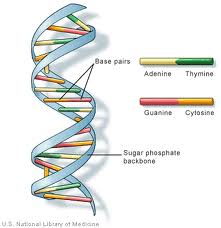
To start with, here is Wikipedia's short introduction to genetics, along with a diagram from the Human Genome Project's piece on basic genetics. So, every organism on earth has a genome, a very long string of genetic information. In all but some viruses, the information is carried in a molecule called DNA, which consists of two 'spines' twisted together and linked by pairs of simpler molecules called 'bases', making something like a giant rope ladder twisted around into a spiral (diagram below thanks to www.chemguide.co.uk). There are only four options (given the letters G, C, A and T) for these bases, so the complete DNA sequence is a long (around three billion letters long in humans!) string of letters: GCCATCGTTCAATACGCC and so on.


Some sections of the DNA sequence, the string of letters, cause proteins to be made. Proteins are the chemicals that form the basis of pretty much everything in any living being; skin, blood, nerves, muscle and much more. In the protein-making sections of the DNA sequence, each little group of three letters gives an instruction for a certain protein component (called an amino acid) to be made. Large parts of the DNA sequence, though, don't seem to do much; a point which I'll come back to later.

On to Francis Collins' book, then. Starting on page 126, he notes that our DNA has much in common with the DNA of other creatures, especially mammals but also fish and even some insects. The amount in common changes quite a lot depending on whether you're looking at parts of the human DNA sequence that code for proteins or at the other, apparently inactive parts (so-called junk DNA). If you start with a stretch of human DNA in a protein-coding area, the chances of finding a similar sequence in other creatures are:

Chimpanzee 100%
Dog 99%
Mouse 99%
Chicken 75%
Fruit fly 60%
Roundworm 35%

But the chances of a close match drop quite a bit if you look at those 'junk' DNA sections:

Chimpanzee 98%
Dog 52%
Mouse 40%
Chicken 4%
Fruit fly almost 0%
Roundworm almost 0%

Doesn't this strike you as odd? Why should the correlation between human and other DNA be much higher in the protein-coding areas than in 'junk' DNA? Collins says it gives support in two ways for an evolutionary understanding of how we came to be. Firstly (from page 129), he notes that we can build up a tree of organisms that shows how closely related they are, based on how much DNA they have in common:
At the level of the genome as a whole, a computer can construct a tree of life based solely upon the similarities of the DNA sequences of multiple organisms... Bear in mind that this analysis does not utilize any information from the fossil record, or from anatomic observation of current life forms. Yet its similarity to conclusions drawn from studies of comparative anatomy, both of existent organisms and of fossilized remains, is striking.

The second point Collins makes is that evolutionary theory predicts a gradual build-up of mutations that do not affect the organism, while mutations that do have an effect will be much rarer. And this is what we see; mutations in the 'junk' DNA sections are far more common than mutations in areas that give instructions for making proteins. This is because most of the latter will severely hamper the individual organism in which they happen, leading to the organism probably not surviving to adulthood and therefore not having any offspring to pass the mutation on to. Only a few mutations in protein-coding areas will be advantageous (or at least neutral) to the organism and stand a chance of being passed on to the next generation.

There's a follow-up to the second point, which relates to the fact that a few DNA mutations don't lead to the protein changing. As I mentioned above, the DNA sequence is basically made up of a huge string of the letters G, C, A and T. In sections of the DNA that cause proteins to be made, each set of three letters gives an instruction for a certain protein component (called an amino acid) to be made. For most of these protein components the set of three letters has to be exactly right, but there are a few where changing one letter in the set for a different letter still leads to the same amino acid being made. And these 'silent' mutations are seen far more often than mutations that do cause a different protein component to be made. I wonder why this might be, if not because evolution is the means by which humanity was created...

Saturday, 30 April 2011

Stage four faith

I have a story to share with you tonight. It's come from the preparation I've been doing for my next course essay, which is going to be about something called 'stages of faith development'. I shall explain what that's all about in a moment but first, here's the story. A guy is relating how he went to a couple of churches when he was around fifteen, partly because he 'was interested in checking out what this Christianity business was all about' but mainly because he 'was interested in checking out the girls'.
The first church I decided to visit was just a few blocks down the street, and it had the most famous preacher of the day, a man whose Sunday sermons were broadcast over every radio wavelength in the land. At the age of fifteen, I had no trouble spotting him as a phony. However, I also went up the street in the opposite direction to another church which also had a well-known preacher, although not nearly as famous as the first. His name was George Buttrick, and at the age of fifteen, I had absolutely no trouble spotting him as a holy man, a true man of God.

My poor fifteen-year-old brain didn't quite know what to make of this. Here was the most famous Christian preacher of the day, and as far as I could see at fifteen, I was already well ahead of him in my spiritual growth. But then, in the same Christian church, there was another preacher who was obviously light-years ahead of me. It didn't seem to make any sense, didn't seem to compute, which is one of the reasons I turned my back on the Christian church for the next twenty-five years or so.
This is an excerpt from M. Scott Peck's book 'Further Along the Road Less Traveled'.
He also notes that during his work as a psychotherapist he realised that religious clients of his who really engaged with the therapy tended to lose their faith, while non-religious clients who engaged tended to become more spiritually minded. Peck came to appreciate that people are in different places, spiritually speaking, and that these places can be grouped into distinct stages. He does offer two important caveats, firstly that others have put forward similar, more scholarly, proposals and that his categories are fuzzy, not rigid. People do not always fall quite as neatly into his psychospiritual pigeonholes, as he might like them to do, Peck writes!

Dave Schmelzer is a church leader who credits Peck's ideas with transforming his attitude towards churches. Schmelzer had become a Christian a while ago but still had what he calls a 'challenging' relationship with churches. This all changed when he read about Peck's stages of faith theory, which suddenly made sense of his frustrations with churches. I'll give a quick summary now of what Peck saw as the stages of faith, so that (hopefully) the rest of what I have to say makes some kind of sense...

Stage 1: Chaotic / anti-social
As toddlers always demand what they feel they need, people in this stage rarely consider other people's feelings, needs or wishes. Peck says that in general, this is 'a stage of absent spirituality and the people at this stage are utterly unprincipled'.
Stage 2: Formal / institutional
This stage is about rules that must be followed, corresponding (Schmelzer says) to a typical child of six or seven. Peck believes that the majority of church-goers fit this stage, being 'dependent on the institution of the church for their governance [and] very attached to the forms of the religion'.
Stage 3: Sceptic / individual
In the next stage, mapping on to many people's experience of teenage life, the person is questioning and doubting, viewing the certainties of stage two with some suspicion.
Stage 4: Mystical / communal
For Peck, there is a stage beyond the doubting and the scepticism, where it is often the case that the beliefs rejected in the transition from stage two to stage three are embraced again, albeit in a rather different form.
So there you have it. Do you recognise yourself in any of these stages? What has particularly struck me about the stages of faith idea is that it explains (maybe) why two Christians can talk together and each think the other is speaking a different language. Or why you can read certain Christian authors and marvel at how different their faith seems to yours... The church that Dave Schmelzer leads is in Cambridge, Massachusetts; a university town like its namesake in the UK. Being the home of two major universities (Harvard and M.I.T.), the town is full of intellectual people who love to debate and question. So these people are unlikely to react positively to a stage two, rules-based kind of Christianity, which sees God as something like a 'giant benevolent cop in the sky' with 'a certain kind of punitive power which He is not afraid to use on appropriate occasions' (quoting from Peck). Here's how Schmelzer describes his experience of this:
When I went to resolutely stage 2 churches, I was baffled... The things they talked about struck me as heady, as abstractions that I perhaps didn't have any quarrel with, but I kept waiting for them to tell me something that would call me into the profound but hopeful and life-changing mystery that I seemed to be entering. Instead, I found their whole purpose was to remove all mystery, as if mystery were the enemy and certainty were what we were looking for.
He says that a different approach is needed to share the good news of Jesus with people who have already rejected an approach to life that is centred on rules and unquestioning obedience. Trying to start stage two type churches in areas full of stage three people just will not work:
Many great people have been commissioned by vibrant, Bible Belt churches to come here [to Cambridge] and start a new church in the heart of paganism. These churches are often faith filled, but they almost always stay quite small. If Peck is right, stage 2, by definition, cannot reach those in stage 3. Stage 3 people, rightly, are never going back. We often meet folks who grew up in stage 2 churches, who led youth groups there, and who then went to college (that home of stage 3) and lost their faith. When they find their way back with us [Schmelzer's church], what they realize is that – to their surprise – they never quit believing in God. What they quit believing in was stage 2.
Mystery and uncertainty are okay in our spiritual life. Daring to ask questions like 'Why do natural disasters happen if God is all-good and all-powerful' doesn't mean your faith is weak. Instead, it may mean that your faith is stronger; because you're daring to ask such challenging questions. In any case, I think our churches and our society in general really must allow people to ask the difficult, uncomfortable questions. In explaining his use of the word 'mystic' for stage four of faith, Peck says this:
Mystics are people who love mystery. They love to solve mysteries, and yet at the same time, they know the more they solve, the more mystery they are going to encounter. But they are very comfortable living in a world of mystery whereas people in Stage Two are most uncomfortable when things aren't cut-and-dried.
And here's what Schmelzer has to say about his vision of what stage four Christianity can be. I think this is just beautiful:
Stage 4 is all about life transformation, about a God who actually does stuff that we very much want done in our lives, a God who navigates his way through all the evil and pain in the world to somehow triumph in the end, both in our moment-to-moment lives and in the world itself... [It's] about this unexpected God, this arresting life changer, this profound mystery who is mysterious primarily because of his profound desire to be known, to be walked with, to be drunk into our thirsty spirits, to be lived.

Saturday, 19 March 2011

'Do whatever you want with everything he possesses'

In this post, I want to look some more at Brian McLaren's view that we can take the Bible as an inspired cultural library, rather than as a legal handbook or constitution (see here and then here for my earlier posts). McLaren uses the book of Job as a case study for this idea.

The title of this post, from chapter one of the book of Job, forms part of a dialogue between God and the devil. Here is the full exchange, from Job 1:6-12:
One day the members of the heavenly court came to present themselves before the Lord, and the Accuser, Satan, came with them. “Where have you come from?” the Lord asked Satan.

Satan answered the Lord, “I have been patrolling the earth, watching everything that’s going on.” Then the Lord asked Satan, “Have you noticed my servant Job? He is the finest man in all the earth. He is blameless—a man of complete integrity. He fears God and stays away from evil.”

Satan replied to the Lord, “Yes, but Job has good reason to fear God. You have always put a wall of protection around him and his home and his property. You have made him prosper in everything he does. Look how rich he is! But reach out and take away everything he has, and he will surely curse you to your face!”

“All right, you may test him,” the Lord said to Satan. “Do whatever you want with everything he possesses, but don’t harm him physically.” So Satan left the Lord’s presence.

So what do you make of this? Did God really permit the devil to cause Job all sorts of grief, taking away all his livestock, killing all his children and most of his servants, and giving him 'terrible boils from head to foot'? If we accept the Bible as a legal handbook then I suppose we do have to think that this conversation and agreement between God and the devil really did happen. But is this the only way of understanding the story, while retaining respect for the Bible as inspired by God? Brian McLaren thinks not...

Through the book, three of Job's friends try to comfort Job and explain why such tragedy has befallen him. McLaren notes that the book of Job concludes with a long speech from God himself, in which God asks Job a lengthy series of questions, rather than giving an explanation (for readers or for Job himself) of the bargain that God made with the devil. God also says of Job's friends, 'I am angry with you... for you have not spoken accurately about me, as my servant Job has.' Here's McLaren's idea:
Perhaps, for the author, or authors of Job, that whole explanation [i.e. God's deal with the devil] for Job's suffering is thus dismissed right along with the pious platitudes of Job's so-called friends. Perhaps?

God has just told us that a large proportion of what is uttered in the book of Job [all the stuff that Job's friends say] is false and foolish. Yet we are taught that the book of Job, being part of the Bible, is the Word of God and is inspired by God. Does that mean that God inspired the introduction and conclusion, but not the middle section where the pious windbags speak? Or does it mean that God inspired the pious windbags' false statements? Or that God was pretending to inspire that part, but was crossing the divine fingers behind the divine back, so as to come out later on to say, 'I was only kidding in that part'?

For McLaren, this makes it clear that we cannot say that God's revelation to us occurs 'independently in every verse of the book of Job'. Instead of occurring in the words and statements of individuals, McLaren believes that God's revelation comes to us in Job through the conversation among individuals and God:
Revelation doesn't simply reside in this or that particular verse of Job like cereal in a box, waiting to be opened and poured out into a bowl. Instead it emerges through the whole story of Job, through the conversation that unfolds among these many voices, like meaning in a novel or perhaps even the punchline in a joke: it creeps up on you, sneaks its way into your thought process and then, when least expected, it surprises you.

So, taking the Reformation cry of sola scriptura ('by scripture alone', or 'scripture is enough'), we should ask what the scripture is enough for. Thinking of the Bible as a legal handbook, we might wish to say that the Bible has given (by itself) enough clarity to resolve all questions relating to following and pleasing God. McLaren again:
From all sides it becomes clear that the Bible, if it is truly inspired by God, wasn't meant to end conversation and give the final word on controversies. If this were its purpose, it has failed miserably. (This fact must be faced.) But if instead it was inspired and intended to stimulate conversation, to keep people thinking and talking and arguing and seeking, across continents and centuries, it has succeeded and is succeeding in a truly remarkable way.

Let's go back to how the book of Job ends, with what McLaren calls a dazzling blizzard of questions. What are these questions for? Certainly not to reveal answers or an explanation or a solution, McLaren says. Rather, the revelation of God comes in these questions as 'a sense of wonder, humility, rebuke and smallness in the face of the unknown'. What if, McLaren asks, that is the truest and best kind of revelation there can ever be for creatures such as us?

Finally, in explaining his view that perhaps the whole story of Job is 'a kind of archetypal theological opera' and not an account of actual events, McLaren says the following:
Through stories like this, gathered in a library like this – not articles or amendments gathered in a constitution – God can self-reveal, so that the Word of God, the speaking and self-revealing of God, can burn like fire in the branches, twigs and leaves of the text.

I know this is a radical departure from the traditional evangelical treatment of the Bible. But it's a departure that, to me, still seems to view the Bible as inspired by God, just with a very different understanding of what that means. I'm sorry if this post is unclear or meandering or just too long, but I'm grappling with and trying to work through McLaren's ideas. They've unsettled me but I also find them compelling and, I don't know, somehow very attractive, so I feel I can't just shrug them off as unorthodox or even heretical.